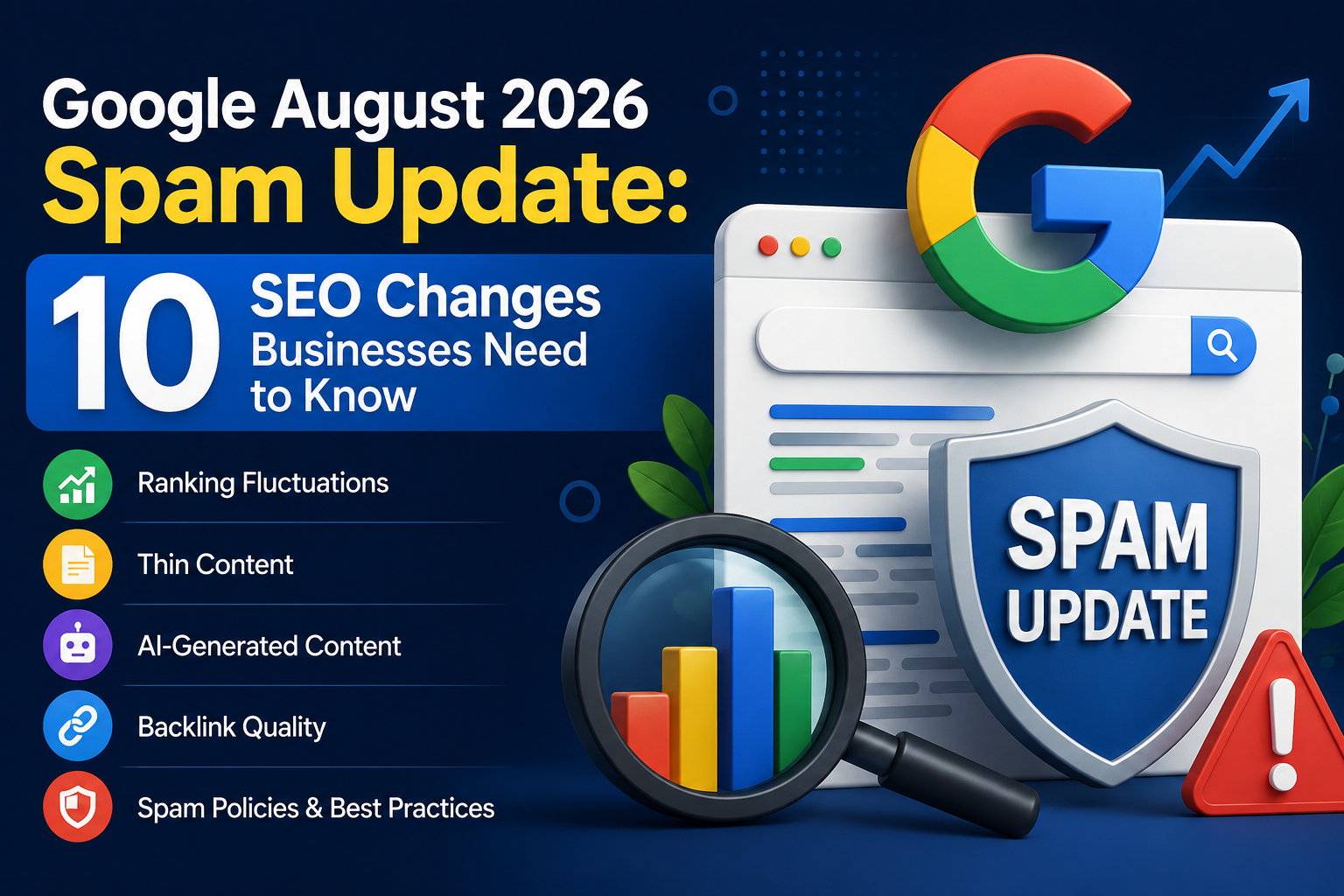
Google Search is constantly evolving, and businesses that depend on organic traffic need to keep a close eye on major algorithm and spam updates. In August 2026, Google began rolling out its August 2026 Spam Update, making this an important time for website owners, marketers, and SEO professionals to review their search strategies.
The August 2026 Spam Update started rolling out on August 18, 2026, globally and across all languages. Google indicated that the rollout could take several days to complete. It is the third confirmed spam update from Google in 2026, following the March and June spam updates.
Importantly, Google has not announced a new spam policy specifically for this update. Instead, businesses should continue following Google’s existing spam policies and focus on creating useful, reliable, people-first content rather than attempting to manipulate search rankings.
For businesses investing in SEO, this update is a good opportunity to evaluate website quality, content, technical SEO, backlinks, user experience, and overall search strategy.
In this guide, we explain 10 important SEO changes and actions businesses should understand following the Google August 2026 Spam Update.
What Is the Google August 2026 Spam Update?
The Google August 2026 Spam Update is a search spam update designed to improve Google’s ability to identify and limit websites that violate its spam policies.
The update began on August 18 and applies globally across all languages. Google has not published a separate announcement identifying a new category of spam that this particular update targets. Therefore, businesses should avoid assuming that one specific tactic or SEO technique is responsible for ranking fluctuations.
Google’s spam systems are designed to detect behaviors that violate its Search spam policies. These policies cover practices that can result in pages being ranked lower or excluded from search results.
If your website experiences ranking changes during the rollout, the first step should be analysis rather than panic.
10 SEO Changes Businesses Need to Know
1. Search Rankings May Fluctuate During the Update
One of the first things businesses may notice during a major Google update is movement in search rankings.
A keyword that previously ranked in position 4 may temporarily move to position 7, while another page may gain visibility. These fluctuations do not automatically mean that your website has received a penalty.
Google’s August 2026 Spam Update is being rolled out over several days, so analyzing a single day’s traffic may produce misleading conclusions.
Businesses should compare:
- Organic clicks
- Organic impressions
- Average position
- Ranking keywords
- Indexed pages
- Landing-page traffic
- Conversion rates
- Branded vs non-branded traffic
Use Google Search Console and Google Analytics to compare performance before and after August 18.
What should you do?
Don’t immediately delete pages, change titles, remove backlinks, or rewrite your entire website.
First determine whether the traffic change is:
- Temporary
- Limited to certain keywords
- Limited to certain pages
- Related to a specific content category
- Related to technical issues
- Actually connected to the spam update
A data-driven diagnosis is much safer than making large SEO changes based on one day’s ranking movement.
2. Thin Content Needs More Attention
Thin content has always been a problem for SEO, but businesses should pay particular attention to pages that provide little genuine value to users.
Examples can include pages with:
- Very little original information
- Repetitive content
- Generic descriptions
- Automatically generated text with limited editing
- Pages created only to target slightly different keywords
- Location pages with almost identical content
- Service pages that do not explain the actual service
Google’s guidance emphasizes helpful, reliable, people-first content rather than content created primarily to manipulate search rankings.
For example, creating separate pages for:
SEO Company Ahmedabad, SEO Company Gujarat, SEO Company Near Me , Best SEO Agency Ahmedabad
is not automatically a problem. However, if every page contains almost exactly the same content with only the city or keyword changed, the pages may provide little additional value to users.
Better approach
Create genuinely useful pages with:
- Unique information
- Local relevance
- Real examples
- Original insights
- FAQs
- Helpful explanations
- Clear service information
- Relevant internal links
Quality should come before keyword quantity.
3. AI-Generated Content Should Not Become Mass-Produced SEO Content
Artificial intelligence is now an important part of digital marketing, but businesses should avoid treating AI as a shortcut for publishing hundreds of low-value pages.
AI can help with:
- Content research
- Topic ideas
- Outlines
- Keyword clustering
- Content editing
- SEO analysis
- Data organization
- Content briefs
However, simply generating large quantities of generic articles and publishing them without meaningful review can create a poor user experience.
Google’s guidance focuses on content that is helpful and created for people rather than content produced primarily to manipulate rankings.
A better AI SEO workflow
A strong content process can look like:
Research → Human strategy → AI assistance → Expert review → Original insights → Optimization → Publishing → Performance analysis
This approach allows businesses to benefit from AI without sacrificing quality.
For companies looking for sustainable organic growth, working with an experienced Best SEO Company in India can help ensure that AI is used as a productivity tool rather than a replacement for SEO strategy and expertise.
4. Programmatic SEO Pages Should Be Audited
Programmatic SEO can be useful when businesses have a legitimate reason to create many pages.
For example:
- Product databases
- Real estate listings
- Travel destinations
- Service locations
- Large e-commerce catalogs
However, automatically creating thousands of pages simply to capture long-tail keywords can create quality problems.
Businesses should audit programmatic pages for:
- Duplicate content
- Very low-value pages
- Empty sections
- Missing information
- Poor internal linking
- Incorrect data
- Pages with no user demand
If a page does not provide useful information to someone who lands on it, ask whether it genuinely deserves to exist.
The goal is not more pages.
The goal is more useful pages.
5. Location Pages Need Genuine Local Value
Local businesses often create multiple location pages to target different cities and neighborhoods.
This can be a good strategy when the business genuinely serves those locations.
But creating dozens of nearly identical city pages can produce a weak website experience.
For example, a business targeting Gujarat might have pages for:
- Ahmedabad
- Surat
- Vadodara
- Rajkot
- Gandhinagar
- Bhavnagar
Each page should ideally provide meaningful information about the business’s service in that location.
Strong local landing pages can include:
- Local service information
- Areas served
- Customer FAQs
- Relevant case studies
- Local business information
- Service-specific details
- Unique examples
- Contact information
- Helpful location-specific content
This is particularly important for businesses targeting searches such as Best SEO Company in Gujarat.
Instead of repeating the same paragraph with different city names, build genuine local relevance.
6. SEO Should Focus More on Search Intent
Another important lesson from modern Google Search is that ranking for a keyword is not enough.
You need to understand why the user searched for that keyword.
Consider these searches:
“SEO meaning”
The user probably wants information.
“SEO services Gujarat”
The user may be researching service providers.
“Best SEO Company in Gujarat”
The user is likely comparing agencies.
“SEO agency Gujarat pricing”
The user may be close to making a purchasing decision.
Each query requires a different content approach.
Match content with search intent
| Search Intent | Recommended Content |
| Informational | Guide / Blog |
| Commercial | Comparison / Service Guide |
| Transactional | Service Page |
| Local | Local Landing Page |
| Navigational | Brand / Business Page |
This approach helps create a more useful website and a stronger overall SEO strategy.
7. Website Quality Matters Beyond Keywords
SEO is not simply about inserting keywords into content.
A successful website also needs:
- Good page experience
- Fast loading
- Mobile usability
- Clear navigation
- Logical website structure
- Helpful content
- Strong internal linking
- Secure HTTPS
- Accessible pages
- Proper indexing
- Good technical implementation
Google’s documentation describes Core Web Vitals as measurements related to real-world loading performance, interactivity, and visual stability.
This means businesses should not focus exclusively on content while ignoring the technical side of SEO.
Conduct a technical SEO audit
Check:
- Robots.txt
- XML sitemap
- Canonical tags
- Indexability
- Broken links
- Redirects
- Mobile usability
- Core Web Vitals
- Structured data
- Page speed
- Duplicate pages
- Internal links
- HTTPS
A technically strong website gives search engines a better foundation for discovering and understanding your content.
8. Review Your Backlink Strategy – But Don’t Panic
Backlinks remain an important part of SEO, but businesses should avoid purchasing or creating links purely to manipulate rankings.
A backlink audit should focus on understanding your overall link profile.
Check:
- Where your links come from
- Whether links are relevant
- Whether links are editorial or manipulative
- Whether there are obvious spam patterns
- Whether your website has unnatural link-building activity
However, businesses should not automatically assume that every ranking drop during the August update is a backlink problem.
The August 2026 update has not been announced as a new link spam update. Google has also not published a specific list of new spam targets for this rollout.
Therefore:
Analyze first. Change second.
9. Improve Your Website’s Originality and Expertise
One of the strongest ways to differentiate your content is to provide information that users cannot easily find everywhere else.
Instead of writing another generic article about:
“10 Benefits of SEO”
create content based on actual experience.
For example:
- SEO case studies
- Ranking improvement examples
- Website audit findings
- Industry-specific strategies
- Local SEO experiences
- Conversion data
- Original research
- Expert opinions
- Practical processes
- Common client mistakes
Original information gives users a reason to visit your website instead of choosing another generic result.
For an SEO agency, this can be particularly powerful.
Instead of simply saying:
“SEO helps businesses increase traffic.”
you can explain:
- Which pages were optimized
- What technical problems were found
- Which keywords were targeted
- What content strategy was used
- How internal linking was improved
- What happened to organic impressions
- Which lessons businesses can apply
This turns generic SEO content into useful expert content.
10. SEO Monitoring Is More Important Than Ever
After a major Google update, businesses should monitor their website instead of making immediate large-scale changes.
Google Search Console should be one of the first places to check.
Monitor:
Search Performance
Track:
- Clicks
- Impressions
- CTR
- Average position
- Queries
- Pages
- Countries
- Devices
Website Analytics
Monitor:
- Organic sessions
- Landing pages
- Engagement
- Leads
- Conversions
- Revenue
Technical SEO
Monitor:
- Indexing
- Crawl issues
- Core Web Vitals
- Structured data
- Manual actions
- Security issues
Google recommends evaluating changes in search performance carefully rather than assuming every ranking fluctuation is caused by a single algorithm update.
What Businesses Should Do After the Google August 2026 Spam Update
If your website has experienced a ranking or traffic change, follow this process.
Step 1: Wait for the rollout to progress
The update began on August 18 and may take several days to complete.
Avoid making major changes while the update is still actively rolling out unless you have identified a clear technical or policy problem.
Step 2: Compare your data
Compare your performance before and after August 18.
Look at:
- Last 7 days
- Previous 7 days
- Last 28 days
- Previous period
- Same period from the previous year
Step 3: Identify affected pages
Determine whether the decline is:
- Sitewide
- Category-specific
- Page-specific
- Keyword-specific
- Location-specific
Step 4: Review Search Console
Check:
- Search performance
- Indexing
- Manual actions
- Security issues
- Search queries
- Landing pages
Step 5: Audit content quality
Look for:
- Thin pages
- Duplicate pages
- Low-value AI content
- Programmatic pages
- Keyword stuffing
- Doorway-style pages
- Poor-quality location pages
Step 6: Review your technical SEO
Check:
- Indexing
- Canonicals
- Robots.txt
- Sitemap
- Redirects
- Internal links
- Mobile experience
- Core Web Vitals
Step 7: Improve instead of panic
Don’t immediately delete hundreds of pages.
First understand what is happening.
Then prioritize improvements based on data.
How Long Does It Take to Recover From a Google Spam Update?
There is no universal recovery timeline.
If a website has been negatively affected by an algorithmic change, recovery depends on:
- The underlying problem
- The number of affected pages
- The quality of improvements
- Google’s ability to reassess the website
- Future algorithm updates
- Overall website quality
Google’s documentation explains that its spam systems continuously evaluate websites and that recovery from spam-related issues may require time for Google’s systems to recognize that the site is following its policies.
Therefore, businesses should be careful with anyone promising:
“We can recover your Google ranking in 7 days.”
SEO recovery is not always immediate.
A professional approach involves:
Audit → Diagnosis → Fix → Improve → Monitor → Reassess
Does the August 2026 Spam Update Affect Every Website?
No.
A spam update is designed to improve Google’s ability to detect spam and enforce its existing policies. It does not mean that every website will lose rankings.
The August 2026 update applies globally and across all languages, but websites that follow Google’s guidelines may see little or no negative impact.
Some websites may even gain rankings if competing websites lose visibility.
This is why businesses should look at their own data rather than assuming that the update automatically caused a traffic decline.
Google Spam Update vs Google Core Update
These two types of updates should not be confused.
Spam Update
A spam update focuses on improving Google’s systems for identifying and dealing with search spam.
Core Update
A core update involves broader changes to Google’s ranking systems.
Google provides separate documentation explaining how core updates work and how site owners can evaluate changes associated with them.
Understanding the difference is important when diagnosing ranking changes.
If your rankings fall, don’t immediately assume:
“Google penalized my website.”
First determine what type of change occurred and whether Google has officially confirmed an update.
What About AI Search and Google AI Overviews?
SEO is also changing because Google Search now includes AI-powered experiences such as AI Overviews and AI Mode.
Google provides guidance for website owners about how their content can appear in AI-powered Search experiences.
Google also launched dedicated Search Console reports for generative AI visibility in June 2026, giving site owners additional ways to understand visibility in generative AI features.
This means modern SEO should not focus only on traditional rankings.
Businesses should increasingly think about:
- Traditional organic search
- AI Overviews
- AI search visibility
- Entity understanding
- Helpful content
- Brand mentions
- Structured information
- Search intent
- User experience
The future of SEO is becoming broader than simply reaching position #1.
How a Professional SEO Strategy Can Help
Algorithm updates are a reminder that SEO should be treated as an ongoing marketing process rather than a one-time activity.
A professional SEO strategy can include:
Technical SEO
Improving website structure, indexing, speed, mobile experience, internal linking, schema and other technical factors.
On-Page SEO
Optimizing:
- Titles
- Meta descriptions
- Headings
- Content
- URLs
- Images
- Internal links
- Search intent
Content Strategy
Creating useful content based on:
- Keyword research
- Search intent
- Customer questions
- Industry trends
- Original expertise
- Commercial opportunities
Local SEO
For businesses targeting Gujarat and specific cities, local SEO can help improve visibility through:
- Google Business Profile optimization
- Local landing pages
- Reviews
- Local citations
- Location-based content
- Local keyword research
SEO Analytics
Monitoring:
- Rankings
- Organic traffic
- Search Console
- Conversions
- Leads
- Landing pages
- Search visibility
This data allows businesses to make informed decisions rather than relying on assumptions.
Why Businesses in Gujarat Should Take SEO Seriously in 2026
Competition in online search continues to increase.
Whether you operate a:
- Manufacturing company
- E-commerce business
- Real estate company
- Healthcare business
- Educational institution
- Professional service
- Local service business
- B2B company
- Hospitality business
your customers are increasingly using search engines to research products, services and businesses.
A strong SEO strategy can help your website reach users when they are actively searching for solutions.
For businesses searching for the Best SEO Company in Gujarat, the right partner should offer more than keyword placement.
A professional SEO strategy should combine:
Technical SEO + Content + Local SEO + Authority Building + Analytics + Continuous Optimization
Why Choose Channelpro Communications for SEO?
Channelpro Communications focuses on helping businesses build stronger search visibility through strategic SEO and digital marketing.
Rather than relying on outdated SEO techniques, businesses should work toward building websites that are:
- Search-friendly
- User-focused
- Technically sound
- Locally relevant
- Content-rich
- Conversion-focused
- Ready for the changing search landscape
If your website has experienced ranking fluctuations following the Google August 2026 Spam Update, an SEO audit can help identify potential technical, content and optimization issues.
Businesses looking for a Best SEO Company in Gujarat can explore professional SEO strategies designed around long-term organic growth rather than short-term ranking tricks.
Final Thoughts
The Google August 2026 Spam Update is an important reminder that SEO is constantly evolving.
The update began on August 18, 2026, and is rolling out globally across all languages. Google has not announced a new spam policy specifically for this update, so businesses should avoid unsupported assumptions about exactly what the update targets.
Instead, focus on the fundamentals:
Create useful content.
Avoid manipulative SEO practices.
Improve technical website quality.
Build genuine authority.
Match content with search intent.
Monitor Google Search Console and Analytics.
Keep improving your website based on real data.
The businesses that treat SEO as a long-term investment rather than a shortcut are better positioned to adapt as Google Search continues to evolve.
If your website has experienced a sudden ranking or traffic change, now is the right time to conduct a detailed SEO audit, identify the actual cause, and create a recovery or improvement strategy based on evidence.
Looking for the Best SEO Company in Gujarat? Channelpro Communications can help your business develop a sustainable SEO strategy focused on search visibility, qualified traffic and long-term digital growth.
Website: Channelpro Communications – https://channelpro.in/
Frequently Asked Questions
1. When did the Google August 2026 Spam Update start?
Google began rolling out the August 2026 Spam Update on August 18, 2026. The rollout is global and applies across all languages.
2. Is the August 2026 update a Google Core Update?
No. It is a Google Spam Update, which is different from a broad core update.
3. Will every website lose rankings?
No. A spam update does not mean that every website will experience a ranking decline. Its purpose is to improve Google’s systems for identifying search spam.
4. Does Google use AI to detect spam?
Google uses automated systems to detect search spam, and its spam systems operate continuously. Periodic spam updates represent notable improvements to those systems.
5. Should I change my website immediately after the update?
Not necessarily. First analyze your Search Console and Analytics data and determine whether your website was actually affected.
6. Can AI-generated content cause SEO problems?
Using AI itself is not the right way to frame the issue. The important question is whether the resulting content is useful, reliable and created for users rather than primarily for manipulating rankings.
7. How can I check whether my website was affected?
Compare your Google Search Console clicks, impressions, average position and affected queries before and after August 18. Also check Analytics for changes in organic traffic and conversions.
8. What should I do if my rankings dropped?
Start with diagnosis. Review the update timeline, Search Console data, technical SEO, content quality, indexing, website structure and spam-policy compliance before making major changes.
9. Is local SEO still important in 2026?
Yes. Businesses that serve specific cities or regions should continue investing in local search visibility, Google Business Profile optimization, location-specific content and other local SEO activities.
10. Can an SEO company help after a Google update?
A professional SEO company can audit your website, identify potential problems, analyze search data and create a structured improvement strategy. However, no ethical SEO company can guarantee a specific ranking or recovery timeframe.