Search is changing rapidly in 2026.
People are no longer relying only on traditional search results and clicking through the familiar list of blue links. Google Search now includes AI-powered experiences such as AI Overviews and AI Mode, while users are also turning to conversational AI platforms to discover information, compare businesses, research products, and find solutions.
This shift has created a new term in digital marketing: GEO, or Generative Engine Optimization.
At the same time, SEO remains one of the most important ways to improve a website’s visibility in search.
So, what is the difference between GEO vs SEO?
Is GEO replacing traditional SEO?
Should businesses invest in GEO instead of SEO?
Or do they need both?
The answer in 2026 is more nuanced than simply choosing one over the other.
Google’s current guidance makes an important point: optimization for its generative AI search experiences is still based on established SEO fundamentals. Google says its AI search experiences are rooted in its core Search ranking and quality systems, meaning businesses should not abandon SEO fundamentals in the race toward AI search.
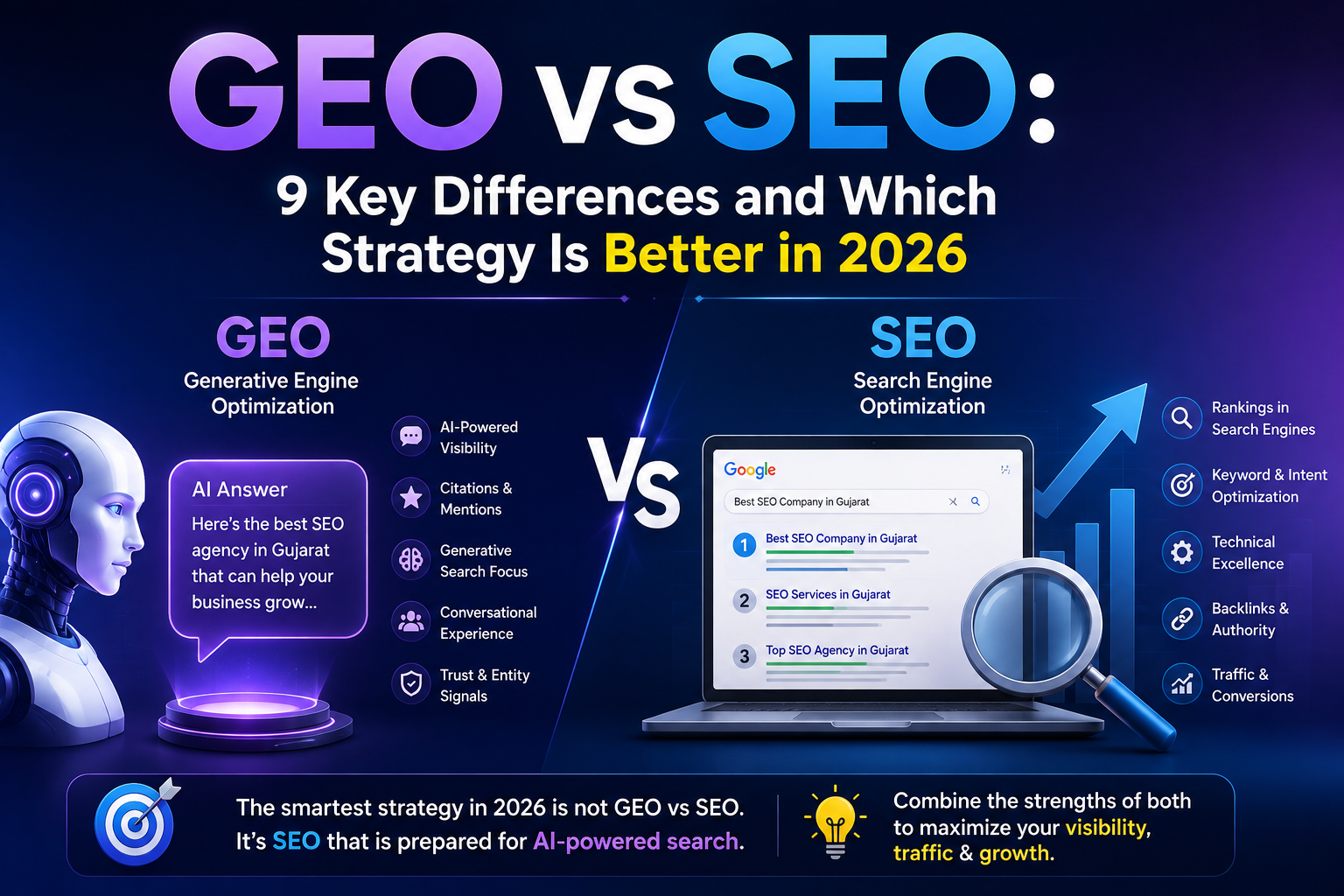
This means the smartest strategy for businesses in 2026 is not GEO versus SEO.
It is SEO that is prepared for AI-powered search.
In this guide, we will explain 9 key differences between GEO and SEO, how they work together, and which strategy businesses should prioritize in 2026.
What Is SEO?
SEO stands for Search Engine Optimization.
SEO is the process of improving a website so that search engines can crawl, understand, index, and potentially rank its pages for relevant searches.
Traditional SEO includes several major areas:
- Keyword research
- Search intent analysis
- On-page optimization
- Technical SEO
- Content optimization
- Internal linking
- Local SEO
- Website architecture
- Structured data
- Digital PR and authority building
- Performance analysis
The objective is to increase relevant organic visibility and bring qualified users to a website.
For example, a business targeting the keyword:
Best SEO Company in Gujarat
might optimize its website around relevant service information, useful content, technical SEO, local relevance, authority, and user intent.
SEO is therefore much broader than inserting keywords into a page.
What Is GEO?
GEO stands for Generative Engine Optimization.
GEO generally refers to optimizing content and online visibility so that a business, website, product, person, or source has a better opportunity to be surfaced, referenced, or cited in generative AI search experiences.
Instead of focusing only on:
“How can I rank this page in traditional search results?”
GEO also considers:
“How can my information become a useful and trustworthy source for an AI-generated answer?”
Generative search can synthesize information from multiple sources and provide users with a direct response.
This creates a different visibility opportunity.
A business might not only want to rank for:
SEO Company Gujarat
but also want its brand, expertise, services, and relevant information to be discoverable when users ask AI systems questions such as:
“What are the best SEO agencies for a small business in Gujarat?”
or:
“How should an Ahmedabad business improve its Google rankings?”
This is where GEO becomes relevant.
However, businesses should be careful about treating GEO as a completely separate replacement for SEO.
Google’s 2026 guidance specifically emphasizes that SEO best practices continue to matter for its generative AI search experiences.
GEO vs SEO: 9 Key Differences
1. Primary Visibility Target
The first major difference is the environment each strategy focuses on.
SEO
SEO traditionally focuses on visibility in:
- Google Search
- Bing
- Other search engines
- Organic search results
- Local search results
- Image search
- Video search
The goal is generally to improve a website’s visibility for relevant searches.
GEO
GEO focuses more specifically on visibility within:
- AI-generated answers
- Generative search
- AI-powered search experiences
- Conversational search
- AI recommendation experiences
- AI-generated summaries
However, these categories increasingly overlap.
Google’s AI Overviews and AI Mode are still connected to Google’s Search systems, meaning traditional SEO remains an important foundation.
The practical takeaway
Businesses shouldn’t build two completely separate websites—one for SEO and another for GEO.
Build a strong website that can be understood by both search engines and AI-powered search experiences.
2. Ranking vs Being Cited or Mentioned
Traditional SEO is strongly associated with ranking.
For example:
Position #1
Position #2
Position #3
and so on.
GEO introduces another visibility concept:
Being mentioned or cited in an AI-generated answer.
An AI search system may provide a response and reference several sources.
This means businesses increasingly need to think beyond:
“Where does my page rank?”
and also consider:
“Is my brand or content being surfaced as a useful source?”
This doesn’t mean traditional rankings are no longer valuable.
In fact, Google’s documentation indicates that its AI search experiences rely on core Search ranking and quality systems.
Therefore, strong SEO can create a foundation for broader AI-search visibility.
3. Keyword Optimization vs Topic and Entity Understanding
Traditional SEO has historically placed significant emphasis on keywords.
For example:
SEO Company Ahmedabad
SEO Services Ahmedabad
Best SEO Company in Gujarat
Local SEO Ahmedabad
These keywords can still be valuable.
However, modern search increasingly requires understanding the broader topic behind those keywords.
For example, the topic:
SEO Company in Gujarat
may involve related concepts such as:
- SEO services
- Local SEO
- Technical SEO
- Content marketing
- Google Business Profile
- Keyword research
- Link building
- Search Console
- Analytics
- AI search
- GEO
- Google Maps
- Search intent
This broader topical understanding helps search systems understand what a business actually does.
GEO therefore tends to emphasize context, entities, relationships, expertise, and information usefulness, rather than relying only on exact keyword repetition.
Better strategy
Don’t write:
Best SEO Company in Gujarat, SEO Company Gujarat, SEO services Gujarat, SEO agency Gujarat…
Instead, create genuinely useful information around the subject and naturally demonstrate expertise.
4. Search Intent Becomes Even More Important
Search intent is already a fundamental part of SEO.
But AI-powered search makes understanding user questions even more important.
Consider the difference between these searches:
Informational
What is SEO?
Commercial
Best SEO Company in Gujarat
Local
SEO company near me
Problem-based
Why is my website not ranking on Google?
Comparative
SEO vs Google Ads – which is better?
AI-focused
How do I optimize my website for AI search?
A strong SEO strategy should understand the purpose behind each query.
For GEO, this becomes especially important because AI systems may interpret longer, conversational questions and combine multiple related concepts when generating a response.
Google has highlighted that AI search experiences can handle longer and more specific questions and follow-up questions.
What should businesses do?
Create content that answers:
- What?
- Why?
- How?
- When?
- Which?
- How much?
- Who?
- What are the alternatives?
This creates a stronger information ecosystem around your business.
5. Traditional Backlinks vs Broader Brand Authority
Backlinks have long been an important component of SEO.
A website can strengthen its authority through relevant, natural links from credible websites.
But AI visibility introduces a broader concept of brand and information authority.
A business can build online credibility through:
- Industry publications
- Relevant websites
- Expert contributions
- Business directories
- Reviews
- Social profiles
- Digital PR
- Original research
- Case studies
- Brand mentions
- Consistent business information
This does not mean businesses should attempt to manufacture mentions everywhere.
Google’s AI search guidance specifically warns against tactics such as creating inauthentic mentions simply to influence AI visibility.
The better approach is to build a real brand with genuine expertise and useful information.
6. Website Content vs Information Ecosystem
SEO traditionally focuses heavily on optimizing a website.
GEO can require businesses to think about their entire online information ecosystem.
For example, a business may have:
- Website
- Google Business Profile
- Social media profiles
- Industry listings
- Review platforms
- Press mentions
- Author profiles
- Business directories
- Product pages
- Videos
- Images
- Third-party references
The more consistent and trustworthy the information is across the web, the easier it can be for users and search systems to understand the business.
This is especially important for local businesses.
For example, if a company claims to be an SEO agency in Ahmedabad, its website, Business Profile, business listings, contact information, service information, and other legitimate online references should provide consistent information.
7. Blue-Link Traffic vs AI Search Visibility
Traditional SEO often measures:
- Rankings
- Clicks
- Impressions
- CTR
- Organic sessions
- Conversions
AI search creates additional visibility questions.
For example:
- Is the brand appearing in AI-generated responses?
- Is the website being cited?
- Which topics generate AI visibility?
- Which pages are referenced?
- Are AI-search visitors converting?
- Is branded search increasing?
Google introduced new Search Generative AI performance reports in Search Console in June 2026, providing dedicated views of visibility from generative AI features such as AI Overviews and AI Mode. The reports are initially being rolled out to a subset of websites.
This is an important development because it makes AI-search visibility increasingly measurable.
The future of SEO reporting
Instead of reporting only:
“We rank #3 for this keyword.”
agencies may increasingly report:
- Organic rankings
- Organic clicks
- AI visibility
- AI-generated impressions
- Brand mentions
- Qualified traffic
- Conversions
This gives businesses a broader view of search performance.
8. SEO Has Established Best Practices; GEO Is Still Evolving
SEO has existed for decades.
It has established disciplines covering:
- Technical optimization
- Crawling
- Indexing
- Content
- Links
- Structured data
- Local search
- Analytics
GEO is newer.
Different platforms can have different systems for discovering, retrieving, evaluating, and presenting information.
This means there is no single universal GEO formula that guarantees visibility across every AI platform.
Businesses should therefore be cautious about agencies promising:
“Guaranteed ChatGPT ranking.”
or:
“Guaranteed AI citation.”
Search and AI systems are complex and continuously changing.
A sustainable strategy should focus on things businesses can actually control:
Useful information + technical accessibility + authority + expertise + clear entities + strong user experience.
9. SEO Is the Foundation; GEO Extends the Search Strategy
This is perhaps the most important difference.
For Google Search specifically, Google’s current guidance makes it clear that generative AI search is still built on core Search systems and that standard SEO best practices remain relevant.
That means businesses shouldn’t abandon SEO to chase every new GEO tactic.
Instead:
SEO provides the foundation.
GEO expands the visibility mindset.
This is why the better question isn’t:
“Should I choose GEO or SEO?”
The better question is:
“How can I make my SEO strategy effective across traditional and AI-powered search?”
GEO vs SEO Comparison Table
| Factor | SEO | GEO |
| Main focus | Search visibility | AI-search visibility |
| Primary goal | Rankings and organic traffic | AI mentions, citations and visibility |
| Core asset | Website | Website + broader information ecosystem |
| Keywords | Highly important | Important, but broader context matters |
| Search intent | Essential | Extremely important |
| Content | Helpful and optimized | Helpful, authoritative and easy to interpret |
| Technical SEO | Essential | Still essential |
| Authority | Backlinks and reputation | Broader authority and trustworthy references |
| Measurement | Rankings, clicks, traffic, conversions | AI visibility + traditional SEO metrics |
The two approaches overlap significantly.
Is GEO Replacing SEO in 2026?
No.
This is one of the biggest misconceptions surrounding AI search.
Google’s current documentation explicitly states that SEO best practices remain relevant for generative AI search experiences. Its AI features are based on core Search ranking and quality systems.
Therefore, businesses should not stop investing in:
- Technical SEO
- Content quality
- Search intent
- Website architecture
- Internal linking
- Crawlability
- Indexability
- Local SEO
- Structured data
- Digital authority
Instead, businesses should make these activities more useful and aligned with how people search in an AI-driven environment.
Do Businesses Need a Separate GEO Strategy?
It depends on the business.
For many businesses, GEO should not be treated as an entirely separate marketing department.
Instead, existing SEO activities can be adapted for AI search.
For example:
Traditional SEO
Create a comprehensive article about:
Local SEO for Small Businesses
AI-ready approach
Make the article:
- Well structured
- Direct
- Comprehensive
- Original
- Supported by real examples
- Easy to understand
- Organized around user questions
- Supported by useful images or videos
- Technically accessible
- Internally linked
Google’s guidance recommends unique, valuable content, good page experience, technical accessibility, appropriate structured data, and useful multimedia for success across its traditional and AI search experiences.
That’s good SEO and it also supports AI-search visibility.
How to Optimize Your Website for GEO in 2026
If you want to improve your website’s potential visibility in AI-powered search, start with the fundamentals.
1. Create Original Content
Avoid producing generic content that simply repeats information already available everywhere.
Add:
- Original research
- Expert insights
- Case studies
- Examples
- Data
- First-hand experience
- Unique explanations
Google has emphasized the importance of unique, valuable, non-commodity content for its AI search experiences.
2. Answer Specific Questions
Create content around real customer questions.
For example:
How much does SEO cost in Ahmedabad?
How long does SEO take to show results?
How does local SEO work?
Why isn’t my Google Business Profile ranking?
What is GEO in digital marketing?
This type of content can address both traditional search intent and conversational discovery.
3. Build Strong Topic Clusters
Instead of publishing random blogs, create connected content.
For example:
Main topic
SEO Company Gujarat
Supporting content:
- SEO Services Gujarat
- Local SEO Gujarat
- Technical SEO
- SEO for Small Businesses
- Google Maps SEO
- SEO vs Google Ads
- GEO vs SEO
- AI Search Optimization
- Google Business Profile SEO
- SEO Case Studies
Then connect these pages with relevant internal links.
This helps users navigate your website and strengthens topical relationships.
4. Strengthen Your Local SEO
For businesses serving a specific region, local SEO remains important.
For an agency targeting Gujarat, build useful location relevance around:
- Ahmedabad
- Surat
- Vadodara
- Gandhinagar
- Rajkot
- Other genuinely served locations
However, don’t create low-quality pages just to insert city names.
Each local page should provide useful, location-specific information.
5. Use Structured Data Correctly
Structured data can help search engines understand content and entities.
However, businesses should not assume that adding special “AI schema” automatically makes a website appear in AI answers.
Google’s 2026 guidance emphasizes that structured data should accurately represent visible page content and follow Google’s guidelines.
Focus on accurate implementation rather than chasing supposed AI shortcuts.
6. Make Your Website Easy to Crawl
AI visibility still depends heavily on search accessibility, especially for Google’s AI search experiences.
Google recommends ensuring that:
- Googlebot isn’t blocked
- Pages return valid responses
- Important content is indexable
- Technical requirements are satisfied
These fundamentals apply to Search generally, including AI experiences.
7. Build Real Brand Authority
Don’t try to manufacture online mentions.
Instead, build a real business presence through:
- Helpful content
- Customer reviews
- Industry participation
- Digital PR
- Expert contributions
- Original research
- Case studies
- Useful resources
The objective is to make your business genuinely recognizable and trustworthy.
8. Optimize for Humans First
One of the biggest mistakes in GEO is trying to write specifically for machines.
Your primary audience is still the human.
Google’s guidance repeatedly emphasizes creating content that fulfills people’s needs and provides unique value.
Therefore:
Don’t write for AI.
Write useful information that AI systems can understand.
That distinction is important.
GEO vs SEO: Which Strategy Is Better in 2026?
For most businesses, SEO is still the essential foundation.
But SEO should evolve to account for AI-powered search.
A strong 2026 strategy looks like this:
- Technical SEO
- Search Intent
- High-Quality Content
- Local SEO
- Topical Authority
- Brand Authority
- AI Search Visibility
- Conversion Optimization
This creates a more complete search strategy.
When Should You Focus More on GEO?
GEO-related optimization may be especially useful for businesses that depend heavily on informational discovery.
Examples include:
- SaaS companies
- Technology companies
- Professional services
- B2B businesses
- Education companies
- Healthcare information websites
- Financial information businesses
- Marketing agencies
- Consultants
- E-commerce brands
- Publishers
These businesses often answer questions that users may increasingly ask through AI-powered search.
Why SEO and GEO Matter for Local Businesses
Imagine someone searches:
“Who are the best SEO agencies in Gujarat for a growing local business?”
Traditional SEO focuses on making your website visible when the person searches relevant keywords.
AI search may instead provide a synthesized answer containing recommendations, explanations, or links.
A strong digital presence gives your business more opportunities to be discovered.
This is why local businesses should focus on:
- Website SEO
- Local SEO
- Google Business Profile
- Reviews
- Helpful content
- Brand consistency
- Relevant online mentions
- Strong service pages
The objective is not simply to rank for one keyword.
The objective is to become a trusted and recognizable entity within your market.
SEO + GEO Strategy for a Business in Gujarat
If you are a business owner in Gujarat, here’s a practical strategy for 2026.
Step 1: Optimize Your Main Service Pages
Create strong pages for your core services.
For example:
- SEO Services
- Local SEO
- Technical SEO
- E-commerce SEO
- Content Marketing
- Digital Marketing
Step 2: Create Location-Relevant Content
If you genuinely serve Gujarat locations, develop useful local content.
Examples:
SEO Company Ahmedabad
SEO Services Surat
SEO Company Vadodara
SEO Consultant Gujarat
But each page should have a clear purpose and useful information.
Step 3: Create Informational Content
Publish blogs that answer customer questions.
Examples:
- How does SEO work?
- How long does SEO take?
- How much does SEO cost?
- SEO vs Google Ads
- Local SEO vs traditional SEO
- GEO vs SEO
- Google AI Overviews
- Google Maps SEO
Step 4: Build Topical Authority
Connect related content using internal links.
For example:
GEO vs SEO
can link to:
- AI SEO
- SEO Services
- Technical SEO
- Content Marketing
- Local SEO
This creates a connected content ecosystem.
Step 5: Track Search Performance
Use:
- Google Search Console
- Google Analytics
- Rank tracking
- Conversion tracking
- Local SEO reporting
- AI visibility reporting where available
Google’s new generative AI reporting in Search Console is an important development to watch as it expands.
Future of SEO in 2026 and Beyond
The future of search will likely become increasingly conversational, multimodal, and AI-assisted.
Users may search through:
- Text
- Voice
- Images
- Video
- Conversational queries
- AI assistants
- Search agents
Google has already emphasized the growing importance of multimodal experiences and useful text, images, and videos for AI-powered Search.
This means businesses should stop thinking about SEO as simply:
“How do I rank this page?”
and start thinking:
“How can my business become the most useful and trustworthy source for this topic?”
That mindset is valuable for both traditional SEO and AI search.
Why Choose Channelpro Communications?
Businesses looking for the Best SEO Company in Gujarat need more than a list of keywords and monthly ranking reports.
A modern SEO strategy should combine technical optimization, useful content, local visibility, authority building, analytics, and adaptation to changes in search.
Channelpro Communications helps businesses approach SEO as a long-term growth strategy.
The focus should be on building a website that is:
- Technically accessible
- Search-friendly
- Helpful to users
- Relevant to search intent
- Locally optimized
- Content-rich
- Conversion-focused
- Prepared for the evolving search landscape
Whether your goal is to improve visibility for Best SEO Company in Gujarat, local search terms, or broader industry keywords, a strong SEO foundation remains essential.
Frequently Asked Questions About GEO vs SEO
What is the difference between GEO and SEO?
SEO focuses on improving visibility in search engines, while GEO generally refers to optimizing information for generative AI search experiences. However, Google’s guidance indicates that optimizing for its generative AI search experiences is still fundamentally based on SEO best practices.
Is GEO replacing SEO?
No. SEO remains important in 2026. Google states that its AI search experiences are based on core Search ranking and quality systems.
Is GEO important for businesses in 2026?
Yes, AI-powered search is becoming an important part of how people discover information. Businesses should understand AI-search visibility while continuing to invest in strong SEO fundamentals.
Can AI-generated content rank on Google?
AI-generated content is not automatically disqualified. However, Google emphasizes that content should provide value and meet its Search Essentials and spam policies. Producing large amounts of AI-generated content without adding value can create problems under scaled content abuse policies.
Does GEO require special schema?
Businesses should not assume that a special “GEO schema” will guarantee AI visibility. Google’s guidance emphasizes accurate structured data that corresponds with visible page content and follows its guidelines.
Should small businesses invest in GEO?
Small businesses should first establish strong foundations in technical SEO, local SEO, useful content, Google Business Profile optimization, reviews, and website quality. AI-search visibility can then become part of the broader strategy.
How can I improve my website for AI search?
Focus on unique and useful content, technical accessibility, strong page experience, clear information, relevant structured data, high-quality multimedia, and genuine expertise. These practices are also valuable for traditional SEO.
How can I track AI-search visibility?
Google began rolling out dedicated generative AI performance reports in Search Console in June 2026. These reports provide visibility data for generative AI features such as AI Overviews and AI Mode for eligible sites.