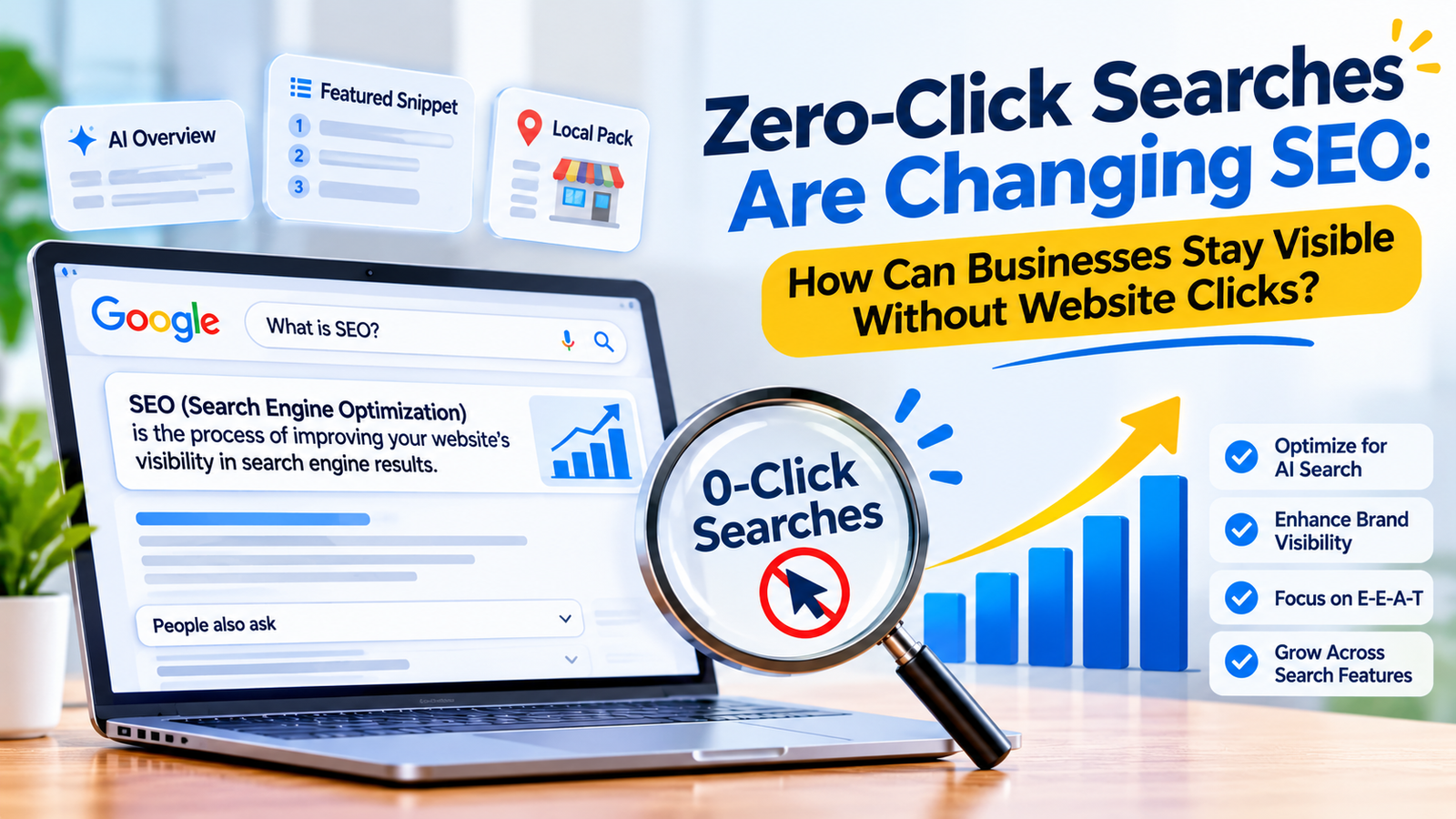
Search behaviour is changing, and businesses can no longer measure their online success through website clicks alone. People increasingly find answers directly on search engine results pages (SERPs), where information such as featured snippets, knowledge panels, local business listings, and AI-generated summaries can answer questions without requiring users to visit another website.
This behaviour is known as a zero-click search. It is changing how businesses approach search engine optimization (SEO), content marketing, and brand visibility.
For businesses, this creates an important challenge: how can a website remain valuable and visible when users find the information they need without clicking through?
The answer is not to abandon traditional SEO. Instead, businesses need to expand their strategies to include brand awareness, search visibility, helpful content, local search optimization, and conversions across different digital channels.
In this blog, we will explore what zero-click searches mean, why they matter, and how businesses can adapt their SEO strategies to maintain online visibility in 2026.
What Are Zero-Click Searches?
A zero-click search occurs when a user searches for something on a search engine and finds the information they need directly on the results page without visiting an external website.
Traditionally, users entered a search query, reviewed the available website links, and clicked on the result that seemed most relevant. Today, search engines provide more information directly within their results.
For example, consider someone searching for:
- What is digital marketing?
- SEO company near me.
- Today’s weather in Ahmedabad.
- How does website development work?
- What are the benefits of social media marketing?
Depending on the query, search engines may display direct answers, featured snippets, maps, business profiles, knowledge panels, or AI-generated summaries.
Users can sometimes complete their search journey without opening any website.
This does not necessarily mean businesses lose every opportunity. Their brand may still appear in search results, answer boxes, or local listings, creating awareness and helping users recognize the company.
Why Are Zero-Click Searches Becoming More Common?
Zero-click searches are becoming more relevant because search engines are evolving from simple link directories into information discovery platforms.
Several developments are contributing to this change.
1. AI-Powered Search Results
AI-powered search experiences can summarize information from different sources and provide users with contextual answers.
Instead of browsing multiple websites, users may receive an overview of a topic directly within the search experience.
For businesses, this makes content quality, accuracy, relevance, and brand credibility increasingly important.
2. Featured Snippets and Direct Answers
Featured snippets display selected information from websites near the top of search results.
They may provide definitions, short explanations, numbered steps, or tables that answer a user’s question.
For example, someone searching for “What is local SEO?” may see a short explanation before the traditional organic listings.
Although users may not always click the source website, appearing in these results can increase brand exposure.
3. Google Knowledge Panels
Knowledge panels display useful information about people, companies, organizations, and other entities.
For businesses, accurate company information across the web can help search engines understand their identity and services.
A well-maintained digital presence supports brand recognition and makes it easier for potential customers to find relevant business information.
4. Local Search and Google Business Profiles
Local searches often provide information directly through Google Maps and business listings.
Users may see business names, locations, contact details, customer reviews, operating hours, and directions without visiting the company’s website.
For local businesses, maintaining an accurate and complete Google Business Profile is therefore an important part of an effective local SEO strategy.
5. People Want Faster Answers
Modern users often prefer quick and relevant information.
When someone wants a business phone number, address, opening hours, or a simple definition, they may not need to visit an external website.
Search engines are adapting to this behaviour by making commonly requested information easier to access.
How Zero-Click Searches Affect Business SEO
Zero-click searches are changing the relationship between search visibility and website traffic. Businesses may receive search impressions and brand exposure even when users do not visit their websites.
Understanding these effects can help companies make better SEO decisions.
1. Website Clicks May Not Reflect Total Brand Visibility
A business can appear in featured snippets, AI Overviews, and local search results without receiving a website visit.
For this reason, businesses should not judge their entire SEO performance based only on organic clicks.
Search impressions, brand searches, business profile interactions, and conversions should also be considered.
2. Organic Traffic Patterns Are Changing
Some informational searches can be answered directly on search results pages. This may reduce the need for users to visit websites for simple answers.
A June 2026 study reported that 68.01% of US Google searches ended without a click during January–April 2026. This is a US-specific finding, not a global figure, and the research uses clickstream data.
Search Engine Land+1
Businesses should therefore evaluate their own website performance rather than assume that every industry or country experiences the same traffic changes.
3. Brand Recognition Is Becoming More Important
When users repeatedly encounter a company in search results, business listings, social media, or AI-generated answers, they may become familiar with the brand.
They might not visit the website immediately, but they may search for the company by name later.
This makes brand awareness, reputation management, and consistent business information important parts of a modern SEO strategy.
4. High-Intent Searches Still Offer Valuable Opportunities
Not all searches have the same purpose.
Someone searching for a simple definition may be satisfied with a direct answer. However, someone searching for a service provider, comparing prices, or looking for a consultation may still need to visit a website.
Businesses should focus on search queries that demonstrate commercial and transactional intent.
For example:
- Best SEO company in Ahmedabad.
- Digital marketing services for small businesses.
- Website development company near me.
- Local SEO agency for business growth.
These searches provide opportunities to connect with users who are actively exploring solutions.
8 SEO Strategies to Stay Visible in a Zero-Click Search Environment
Businesses should adapt their SEO approach to include both website traffic and visibility across search results.
Here are eight practical strategies that can help.
1. Optimize Content for Featured Snippets
Featured snippets can display selected information from a website directly in Google search results.
To improve the chances of your content being considered for these results:
- Answer common questions clearly.
- Use descriptive H2 and H3 headings.
- Include relevant definitions and explanations.
- Use numbered lists for step-by-step instructions.
- Create comparison tables where useful.
- Keep paragraphs focused and easy to understand.
For example, a blog targeting the keyword “What is technical SEO?” can begin with a short, accurate definition before explaining the topic in detail.
There is no guaranteed method to secure a featured snippet, but well-organized and helpful content can improve its usefulness for searchers.
2. Strengthen Your Google Business Profile
For businesses targeting local customers, Google Business Profile optimization is an important part of a zero-click SEO strategy.
Users may discover a company, read reviews, check its location, and contact the business directly from Google Search or Maps.
Businesses should:
- Maintain accurate business information.
- Choose relevant business categories.
- Add detailed service information.
- Upload genuine business photographs.
- Publish relevant updates.
- Collect authentic customer reviews.
- Respond to customer questions and feedback.
- Keep opening hours updated.
A complete profile can help potential customers discover and contact a business without necessarily visiting its website.
3. Create Content That Answers Search Intent
Understanding search intent is essential when creating content for modern search experiences.
Instead of targeting keywords without considering their purpose, identify what users actually want to know.
For example:
| Search intent | Example query | Recommended content |
| Informational | What is SEO? | Educational blog |
| Commercial | Best SEO agency for small businesses | Service comparison guide |
| Transactional | Hire an SEO company in Ahmedabad | SEO service landing page |
| Navigational | ChannelPro Communications | Brand and contact pages |
This approach helps businesses create relevant content for different stages of the customer journey.
4. Build Strong Brand Authority
In a competitive digital environment, businesses need more than keyword rankings to establish a recognizable online presence.
Brand authority can be strengthened through consistent and useful information across different platforms.
Consider:
- Publishing industry-related articles.
- Sharing original insights and case studies.
- Maintaining active social media profiles.
- Getting genuine mentions from relevant websites.
- Building relationships with industry publications.
- Keeping business details consistent.
- Encouraging authentic customer feedback.
A recognizable brand can encourage users to search for the company directly, even if they first discover it through a search result or another platform.
5. Target Long-Tail and High-Intent Keywords
Broad keywords often attract users with different interests and search intentions.
Long-tail keywords help businesses focus on more specific customer needs.
For example, instead of targeting only “SEO services,” consider:
- SEO services for small businesses in Ahmedabad.
- How to improve Google Business Profile rankings.
- Affordable website SEO audit services.
- Local SEO strategies for service-based businesses.
- How to generate leads through organic search.
Create dedicated pages or useful blog sections for relevant topics rather than publishing repetitive content for every keyword variation.
6. Add Original Insights and Valuable Information
Generic content is easier for search engines and AI systems to summarize. Businesses should offer something more useful than basic information already available across multiple websites.
Some ways to make content more valuable include:
- Sharing practical industry experience.
- Including original research and data.
- Publishing genuine customer success stories.
- Explaining processes with real examples.
- Providing detailed service comparisons.
- Sharing expert opinions and observations.
For example, a digital marketing agency can publish an article explaining how it approaches keyword research for local businesses, including the factors it considers when selecting target keywords.
This creates a stronger reason for users to visit the website and explore the full content.
7. Use Structured Data Correctly
Structured data helps search engines understand specific information about a webpage.
Depending on the page and its content, businesses may use relevant schema types such as:
- Organization schema.
- LocalBusiness schema.
- Article schema.
- BreadcrumbList schema.
- Product schema.
- Service-related structured data where supported.
Make sure structured data accurately represents the visible content on the page and follows Google’s guidelines.
Importantly, adding schema does not guarantee rich results, featured snippets, or AI search visibility. It should support a well-organized website rather than act as a shortcut to higher rankings.
8. Diversify Your Digital Marketing Channels
Businesses should not depend entirely on organic website clicks from Google.
A stronger digital marketing strategy includes multiple ways for potential customers to discover and interact with a brand.
These may include:
- Search engine optimization.
- Social media marketing.
- YouTube marketing.
- Email marketing.
- Content marketing.
- Online reputation management.
- Local business listings.
- Paid search advertising.
For example, a customer may discover a company through Google, watch its videos on YouTube, read its social media posts, and eventually visit the website to submit an enquiry.
A connected digital presence creates more opportunities to reach potential customers.
How to Measure SEO Success Beyond Website Clicks
One of the biggest changes businesses need to make is how they evaluate SEO performance.
If zero-click searches are increasing, relying only on website sessions may provide an incomplete picture of search visibility.
Businesses should monitor a broader set of performance indicators.
1. Google Search Console
Google Search Console helps businesses understand how their websites appear in Google Search.
Important metrics include:
- Total impressions.
- Total clicks.
- Click-through rate.
- Average search position.
- Top-performing search queries.
- Page-level search performance.
- Indexing status.
An important 2026 update: Google rolled out a dedicated Generative AI performance report in Search Console worldwide from August 31, 2026. It provides impression data for supported generative AI features in Google Search, including AI Overviews and AI Mode.
Search Console Help+1
This gives website owners an additional way to evaluate visibility beyond traditional search result reporting.
2. Google Analytics 4
Google Analytics 4 helps businesses understand what visitors do after reaching their websites.
Monitor:
- Organic sessions.
- Active users.
- Engagement rate.
- Engaged sessions.
- Key events.
- Form submissions.
- Conversion activity.
These measurements help identify whether organic search visitors are engaging with the website and taking meaningful actions.
3. Google Business Profile Performance
For local businesses, Google Business Profile performance can provide useful information about customer interactions.
Monitor available metrics such as:
- Business profile views.
- Search terms.
- Website clicks.
- Calls.
- Direction requests.
- Other available customer interactions.
These measurements help businesses understand how customers discover and interact with their local listings.
4. Brand Search Performance
Track how often users search for your company name and related branded terms.
For example, ChannelPro Communications can monitor searches containing its brand name and variations.
Growing branded search interest may indicate increasing awareness, although it should be evaluated alongside other marketing activities and business performance.
5. Leads and Conversions
Ultimately, businesses need to understand whether their digital marketing activities contribute to enquiries and revenue.
Track:
- Contact form submissions.
- Phone enquiries.
- Consultation requests.
- Qualified leads.
- Service enquiries.
- Conversion rates.
The objective is to understand the quality and business value of search visibility, not simply the number of visits.
Common Zero-Click SEO Mistakes Businesses Should Avoid
While optimizing for zero-click searches, businesses should avoid practices that can weaken their overall SEO performance.
1. Focusing Only on Rankings: A high search position does not always translate into website visits. Monitor impressions, clicks, engagement, and conversions together.
2. Ignoring Website Content Quality: Do not publish short or generic content simply to answer search queries. Provide useful explanations, original insights, and relevant information.
3. Neglecting Local SEO: Businesses serving specific locations should maintain accurate business listings and regularly manage their online reputation.
4. Overusing Keywords: Adding the same keyword repeatedly does not improve content quality. Use keywords naturally and focus on satisfying search intent.
5. Ignoring Brand Awareness: Search visibility should be supported by consistent branding, useful content, social media activity, and customer trust.
6. Depending on a Single Traffic Source: Search algorithms and user behaviour can change. Build a digital presence across multiple relevant channels.
7. Forgetting Conversion Optimization: Even when visitors reach your website, unclear service information or difficult contact processes can prevent enquiries.
The Future of SEO: From Click-Based Rankings to Search Visibility
SEO is moving towards a broader approach where visibility, brand recognition, and customer engagement matter alongside website traffic.
Search engines are introducing more ways for users to discover information without opening external websites. At the same time, users continue to visit websites when they need detailed information, original insights, product comparisons, or professional services.
This means businesses should not treat zero-click searches as the end of SEO. Instead, they should use them as an opportunity to rethink how their brands appear across digital platforms.
A successful SEO strategy should combine:
- Traditional search engine optimization.
- Local SEO and Google Business Profile management.
- Helpful and informative content.
- Featured snippet optimization.
- AI search visibility.
- Brand authority and reputation management.
- Technical website optimization.
- Conversion tracking and performance reporting.
Businesses that adapt to these developments can build a more sustainable digital presence and create opportunities to connect with customers at different stages of their buying journey.
Frequently Asked Questions (FAQs)
1. What is a zero-click search in SEO?
A zero-click search happens when users find the information they need directly on a search engine results page without clicking on an external website. Featured snippets, knowledge panels, local listings, and AI-generated summaries are common examples.
2. Do zero-click searches negatively affect website traffic?
They can reduce website visits for certain informational searches because users may find answers directly on search results pages. However, the impact varies by industry, search intent, and keyword type.
3. How can businesses rank in zero-click search results?
Businesses can improve their opportunities by publishing helpful content, answering relevant questions, using clear headings, maintaining accurate business information, and following technical SEO best practices. However, appearing in a specific zero-click feature cannot be guaranteed.
4. Is Google Business Profile important for zero-click SEO?
Yes. Google Business Profile helps local businesses display important information such as location, contact details, reviews, services, and operating hours directly in Google Search and Maps.
5. How can businesses measure SEO performance without relying only on clicks?
Businesses can monitor search impressions, brand searches, business profile interactions, AI search visibility, referral traffic, leads, and conversions. These metrics provide a broader picture of online performance.
6. Is traditional SEO still relevant in 2026?
Yes. Traditional SEO remains important for website crawling, indexing, search visibility, and organic traffic. Google also confirms that its existing SEO fundamentals remain relevant for AI-powered search experiences.
Google for Developers+1
Conclusion
Zero-click searches are changing how businesses approach online visibility, but they do not make SEO less important. They highlight the need for a broader strategy that focuses on being discoverable, building brand recognition, and connecting with potential customers across different digital touchpoints.
By combining traditional SEO, local search optimization, quality content, brand building, and performance tracking, businesses can adapt to changing search behaviour.
ChannelPro Communications helps businesses strengthen their online presence through strategic SEO and digital marketing practices. Whether your goal is to improve search visibility, reach local customers, or generate more qualified enquiries, a well-planned digital strategy can support your business growth.
Explore our services at ChannelPro Communications and take the next step towards building a stronger online presence.